Awadhi cuisine did not emerge from necessity. It emerged from a royal court that had time, money, and an obsession with refinement — and that turned the kitchen into a space of deliberate, sustained artistry.
The Nawabs of Awadh ruled from Lucknow in the 18th and 19th centuries, and their contribution to Indian cuisine is still felt in every biryani, every korma, every kebab that traces its lineage back to those kitchens. What they left behind was not just a set of recipes — it was a philosophy of cooking.
The Court Kitchen
In the Nawabi court, cooking was not a servant's task — it was a skilled art form that commanded respect and resources. The royal kitchen employed hundreds of cooks, each specialising in a narrow domain. One cook for bread. Another for kebabs. Another for rice. Another for gravies. The depth of focus that specialisation allowed produced dishes of extraordinary refinement.
The Nawabs were also intensely competitive about food. Legend holds that they would hold cooking contests — chefs competing to produce the most delicate dish, the most perfectly balanced flavour, the softest texture. The pressure of that competition drove innovation in a way that peaceful kitchens rarely do.
Dum Pukht — Patience as Philosophy
The technique that defines Awadhi cooking is dum pukht — literally, "breathed and cooked." Meat, spices, and liquid are sealed inside a heavy pot, the lid pressed shut with dough, and cooked over the lowest possible flame. Sometimes for hours. Sometimes overnight.
The steam that builds inside cannot escape. It circulates, carrying flavour from the spices into the meat and back again, building layers of complexity that no amount of stirring or high heat can replicate. The dum technique was not invented out of necessity but out of philosophy — the idea that the best flavours are the ones given time, sealed in, and allowed to find each other slowly.
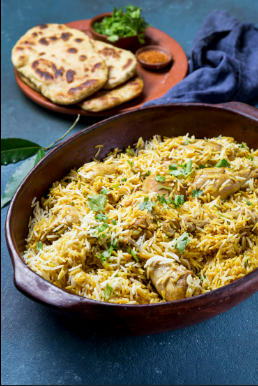
Lucknowi biryani — the pakki biryani, where the rice and meat are cooked together in dum — is its most celebrated product. Unlike the Hyderabadi biryani where raw meat is cooked with rice, the Awadhi version pre-cooks both before sealing them together. The result is a subtler integration of flavours, the rice absorbing the meat's essence rather than cooking alongside it.
The Persian Thread
The Nawabs of Awadh traced their origins to Persian nobility, and Persian culinary traditions ran through everything they cooked. The use of saffron, rose water, kewra, dried fruits and nuts in savoury dishes — these were Persian imports that became Awadhi signatures. So was the preference for restraint over intensity: Awadhi spicing is complex but never aggressive, layered but never overwhelming.
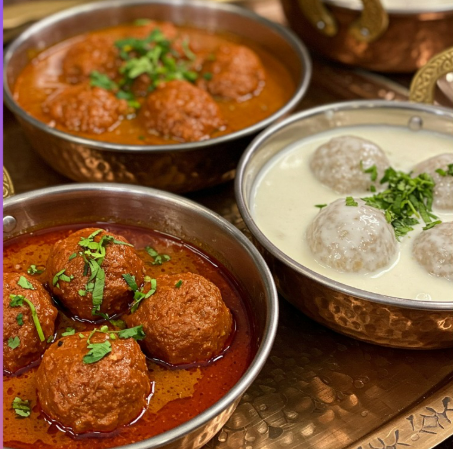
Korma — slow-cooked meat in a yogurt and nut gravy — is the purest expression of this Persian-Awadhi synthesis. The technique is Mughal, the flavour profile is Awadhi, and the result is a dish that has survived the courts, the colonial period, and the convenience kitchen to remain one of the most sophisticated things you can make.
A Living Legacy
The royal courts of Awadh no longer exist, but their culinary traditions continue to live on in homes, restaurants, and kitchens across India. Each plate of biryani, korma, or kebab carries a small piece of that history — a reminder of how the passion of a few royal patrons helped shape one of India's most refined and beloved cuisines.
When you make a Lucknowi biryani at home — sealing the pot, lowering the flame, waiting — you are doing something the Nawabs would have recognised. The technique survives because what it produces cannot be achieved any other way. Some things require patience. The Awadhi kitchen understood that before almost anyone else did.