I miss the chatter. The kitchen was our 'news box' — family secrets were passed down through osmosis, not just recipes. You stood close enough to watch, and in watching, you absorbed things that were never formally taught.
There was a way my grandmother held the pressure cooker lid. A particular sound she listened for before turning down the flame. The angle at which she added water to the dough. None of it was written anywhere. None of it was explained. It was transmitted through proximity — through hours spent in the same room, doing the same things, until your hands knew what hers knew.
The Kitchen as News Box
The kitchen used to be the room where everything happened. Not just cooking — negotiating, gossiping, deciding, planning. It was where the adults talked while their hands were busy, and where children absorbed the texture of family life without anyone intending to teach them anything.
That proximity was how knowledge moved. Recipe knowledge, yes — but also the knowledge of how to manage, how to improvise, how to taste something and understand what it needed. The kitchen was a classroom that never announced itself as one.
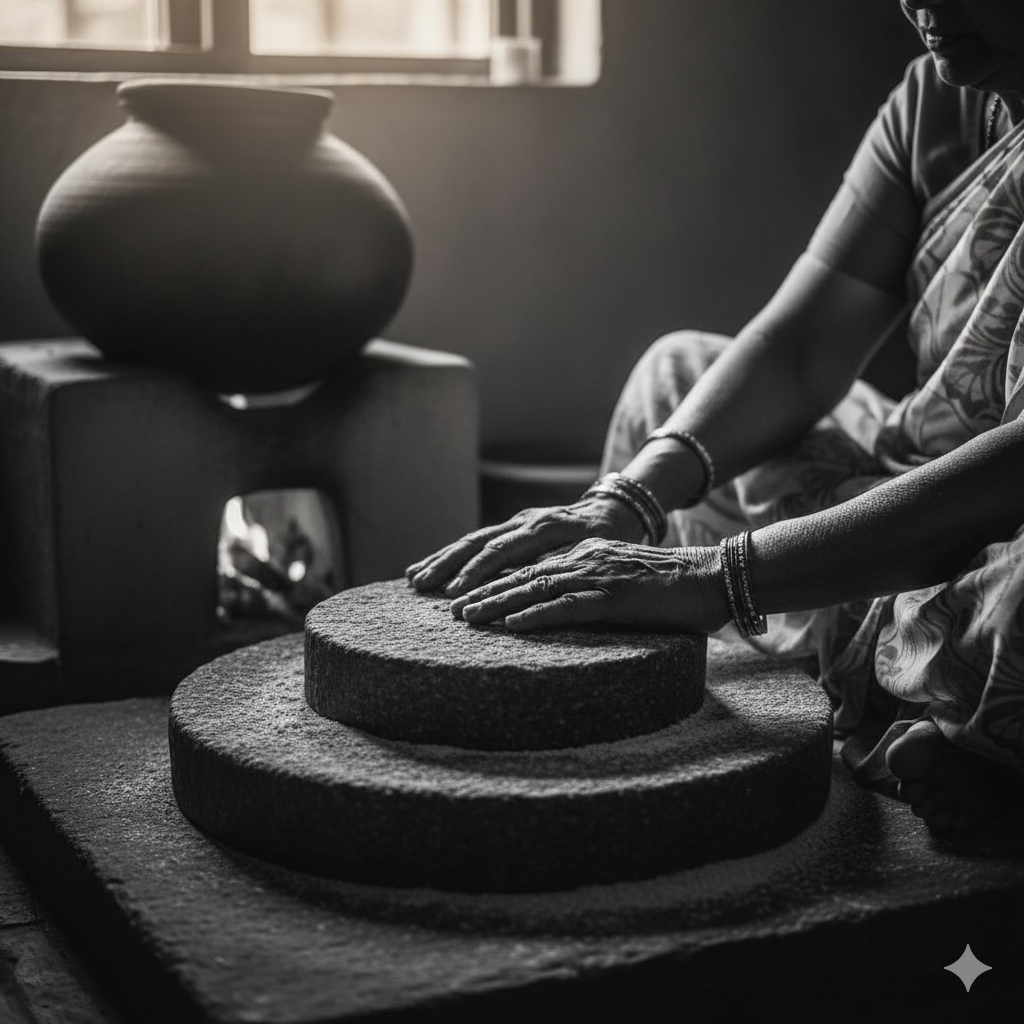
The Manual Grind
Then the manual grind was replaced — first by mixers, then by processors, then by appliances that did the waiting so we didn't have to. Each replacement was logical. Each one made sense. Why grind by hand when a machine does it better and faster? Why knead for twenty minutes when a stand mixer achieves the same result in six?
The answer, if there is one, isn't that hand-grinding is superior. It's that the time spent doing it was never only about the grinding. It was about being present in the kitchen long enough for something else to happen — a conversation, an observation, a moment of attention paid to what the food was doing and why.
The Freedom to Leave
Modern kitchen appliances gave us the freedom to leave. Set the cooker, leave the room. Start the machine, do something else. The kitchen stopped being a place you stayed and became a place you visited. That's a genuine gain — the exhaustion of those hours was real, and not everyone should have to carry it.
But something left with the exhaustion. The accumulated hours of attention paid to food, the gradual development of instinct, the knowledge that only comes from watching the same process hundreds of times. You can't compress that into a recipe card. And when the kitchen stopped being a place people lived in, a lot of that knowledge stopped being transmitted.
What Remains
What remains is the cooking itself — and the decision to pay attention to it. The appliances are not the problem. Leaving the room entirely is. The question Kitchen Evolution keeps asking is not whether we should go back, but whether we noticed what changed when we walked out. Most of the time, we didn't.
I didn't, until I started trying to reconstruct what my grandmother knew — and realised I was working from memory of watching, not from memory of doing. There's a gap there. And the only way to close it, a little, is to stay in the kitchen long enough for the same quiet transmission to happen. To whoever is standing close enough to watch.